Tuesday, September 14, 2010

Taiko no Tatsujin- Go! Go! Godaime! song list

Taiko no Tatsujin go Go Godaime boxart

The 5th PS2 Taiko game, released on December 2004. As the title suggests, this is the console game to introduce Go-Go Mode to the Taiko series, where choruses of songs light up with fire and extra points are handed out to the player. Doron Mode (invisible notes) was also introduced in this version, together with the Yam note. In fact, the theme song of Godaime sings about yam half the time too. Godaime is pretty vocal about the changes it made to the Taiko series.

Doron Mode can't be unlocked or selected normally, and can only be accessed through a secret code in the game involving setting a specific name to a new save file. This trick, and together with later game modifiers, is repeated for all later Taiko games released on PS2 and PSP. Only after Taiko DS1 was released do the game modifiers have standard unlocking methods and the ability to be selected freely.


~ Ending Movie variants ~
Muzukashii mode credits
Futsuu mode credits
Kantan mode credits

Monday, September 13, 2010

Boss Battle! Wii Selection

Boss battles are a part of Taiko no Tatsujin Wii 2, like in the DS Taiko game before that, brought over because of popularity.

Over the course of the storyline, Don and Katsu, together with their newly found friend Arumi-chan, will have to protect an ongoing festival from being under attack by a fun-hating mad scientist, Dr. Waruru, using the only way they know how, through the power of the Don Spirit! (basically by playing the taiko, the Don Spirit is evoked as power)

The rules are simple. You will play a song with the mecha opponent on the screen. The regular gauge is replaced with two life bars, one for you and one of the mecha. The objective is to lower the opponent's life gauge by playing well throughout the song avoid missing notes and hitting bomb notes, which lower your drum's life.

But the play is often disturbed by your opponent, who sometimes can try to distract the player by covering part of the screen, change the scrolling bar's speed, bomb notes, fight notes and so on. The boss battles can be played in one of three difficulty settings, Ama-guchi, Kara-guchi, and Geki-kara (with the third being the hardest).

If your life bar is longer than the opponents' when the song ends, you win!

Spoiler warning ahead.

Sunday, September 12, 2010

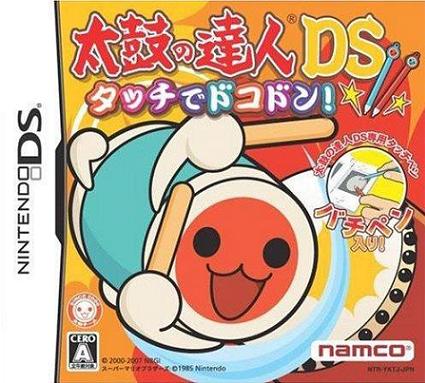
Taiko no Tatsujin DS: Touch de Dokodon! unlock guide


Taiko no Tatsujin: Atsumare! Matsuri da! Yondaime song list

Taiko no Tatsujin Atsumare Matsuri da Yondaime boxart

The 4th PS2 Taiko no Tatsujin game, released on July 2004, and is the first Taiko game to upgrade to the PS2-grade graphics engine (Namco System 256), even before the arcade did. As a result, the subsequent arcade releases of Taiko 7 and 8 use Yondaime's in-screen menus as their song list/menus layout format.

Yondaime set the trend for unlocking hidden material for the rest of the PS2 and the first two PSP games; the Don Point system. You're awarded a certain number of these points every time you clear a song or complete a minigame. The amount you get depends on the difficulty of the song and your performance. Go past a certain point total and something gets unlocked, whether it's a song, Taiko sound, or the Oni difficulty.

The modes have also been overhauled. Instead of a two-song Arcade Mode, Survival Mode and Battle Mode, everything has been discarded and replaced with a Play Mode (Ensou Game, the main mode where you play everything), where you're allowed to play through the songs as much as you want without restriction (similar to the Free Mode from older PS2 Taiko games). Minigames still prevail through the makeover. Auto-Play also becomes an official modifier option, with Mekadon from Sandaime appearing on the top-left corner instead of Don-chan.

Just for this game and the next, difficulty stars in Kantan aren't regulated. There are actually 6* songs in Kantan in this version and in Taiko PS2 5. Of course, all 6* have been cut to 5* soon after.


~ Ending variants ~
Don-chan Sekai Ryoko (Muzukashii)
Don-chan Sekai Ryoko (Futsuu)
Don-chan Sekai Ryoko (Kantan)


Saturday, September 11, 2010

Hidden content rumors in Taiko 14

Anime
・LISTEN TO THE STEREO!! (Ura)

Game Music
・Make Inu Henjou (負け犬返上)  Released
・KARMA(Tatsujin Mix) Released
・No Way Back (Ura)  Released

Namco Original
・Mulberry Released
・SORA-IV Bunpasong (SORA-Ⅳ ブンパソング)Released
・Taiko Time (Ura) (タイコタイム(裏)) Released
・Hikari no Kanata e (ヒカリノカナタヘ) Released
・Hikari no Kanata e (Ura) (ヒカリノカナタヘ(裏)) Released
・Arumujika ac14.0V (アルムジカac14.0V)  Released
・Shunyuu ~happy excursion~ (Ura) (春遊(裏)) Released
・Senpuu no Mai (Ura)  Released
・Shimedore 2000 (〆ドレー2000)  Released

Revived Namco Originals
・Kurofune Raikou (黒船来航) Released
・Hyakka Ryouran (百花繚乱)  Released
・Karui Zawameki (軽いざわめき) Released
・Go Go Kicchin (ゴーゴーキッチン) Released
・Fuun! Bachi o Sensei (風雲!バチお先生)Released
・Fuun! Bachi o Sensei (Ura) (風雲!バチお先生(裏)) Released

With the 6th 7th secret code out, everything in this list has been accounted for...save for one song. Mistake?

Thursday, September 9, 2010

Taiko no Tatsujin 14- Soroban 2000 Morse Code


Once more, the infamous Advanced Notes Morse Code messages for Soroban 2000 have invaded Taiko 14. They span all four difficulties. Being released today, no one's tried to decode it yet, but stay tuned for more updates! I'll add this to the Morse Code page as soon as I hear any results!

For the uninitiated, read up on what it all means here!

So, what's this then?


The enigmatic picture hidden in the folds of HTML code on the Taiko Team's blog a week ago. Now that all the new 10* songs have been revealed and recorded, we can safely confirm that none of them are the song shown in this picture. New 2000? Are you there?

Namco is teasing us.