Showing posts with label taiko ps2. Show all posts

Monday, February 21, 2011

Taiko Drum Master unlock list

Oni difficulty - Clear and pass 25 songs on Muzukashii (Hard) mode, or get a total play time of one hour

Songs
---------------------------------
Taiko March
-Get 5 crowns
Don Rangers 
-Get 10 crowns
Ridge Racer
-Get 15 crowns
The Genji and the Heike Clans (KAGEKIYO)
-Get 20 crowns


Back to Taiko Drum Master song list

Wednesday, January 5, 2011

Taiko no Tatsujin: Waku Waku Anime Matsuri unlock list


Oni difficulty- Play Arcade mode once each on Kantan, Futsuu and Muzukashii, or get a total play time of 3 hours.

Songs
---------------------------------
Wadaiko Sentai Don-Ranger (和太鼓戦隊ドンレンジャー)
-Play Arcade mode on Futsuu/Muzukashii a total of five times


Back to PS2 Anime 1 song list

Tuesday, October 26, 2010

Taiko Towers!


The Taiko Tower challenges in Taiko no Tatsujin: Doka! to Oomori Nanadaime (a.k.a. Taiko PS2 7) are a series of ten survival challenges against all the tricks the game can pit against you. It's a minigame found in the Waku Waku Bouken Land. The rules are slightly different in that unlike the regular mode, it's possible to fail in the Taiko Tower if you do badly. The 魂 flames on the top-right corner of the screen indicate how many times you're allowed to miss before you lose. While all this is happening, Don-chan continuously climbs the tower to its summit on the bottom of the screen, and announces each time he climbs ten floors.

Most of the Taiko Towers let you play without any music in the background, but with a slowly building BPM that goes faster and faster until you finish, piling on the difficulty and the speed. As mentioned before, there are ten in all, each harder than the last. Two difficulty settings are available, Ama-kuchi (甘口) and Kara-kuchi (辛口), the latter being Hard mode. All videos below are done on Kara-kuchi.

In all the Taiko Tower challenges, the Bachi o Sensei wear different clothing.

Saturday, October 16, 2010

Taiko no Tatsujin- Doka! to Oomori Nanadaime song list

Taiko no Tatsujin Doka to Oomori Nanadaime boxart

The seventh and final PS2 Taiko game, released just in time for Christmas, on December 2006. One of the most successful versions of the game on this console, not least because of its expansive song list and wonderful song choice. Nanadaime was the one which introduced us to some of the most memorable tracks in the entire series. After 2 to 3 PS2 games without an ending theme, Nanadaime lets it go with a bang- it has both an opening and an ending song, the latter of which has become one of the most enduring classics in Namco Original, Densetsu no Matsuri (The Legendary Festival).

The final game modifier, the Reverse mode, was added here. The gameplay remains largely the same aside from that. What's different was the addition of the Waku Waku Bouken Land, which features ten sets of increasingly difficult challenges, the Taiko Towers. Each of them are very clever, innovative spins on the different aspects of Taiko, including multiple balloon and yam notes, increasing BPM, and fast notes hidden behind slow drumrolls. It's here that the nonstop note streams of the Ura Oni mode of Yawaraka Sensha was made.


List and videos of all Taiko Towers


Tuesday, October 5, 2010

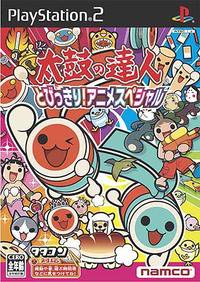
Taiko no Tatsujin: Tobikkiri! Anime Special

Taiko no Tatsujin Tobikkiri Anime Special boxart

The second and final anime song compilation on PS2 Taiko, released on August 2005. Much has changed since the release of Anime Matsuri, the graphics have been improved greatly, the music is of higher quality, new and better gameplay mechanics were introduced, and the song list is beefed up. Game modifiers, Go-Go Time and the new genres were introduced along the way to Anime Special's release. As usual, the majority of songs in this game are in the Anime genre, with a small number of Namco Originals.

In terms of game mechanics, this is also the first Taiko to show the number of times you hit drumrolls on the screen (this carries over to Rokudaime and all subsequent versions). The song list includes Rising Weather Hallelujah (or, Kaisei Joushou Hallelujah), the first 10* Oni Anime song of the whole series.

By the end of August of the same year, a soundtrack CD of the game was released with 23 of its songs on one disc, including half the anime list and popular Namco Originals.


Saturday, October 2, 2010

Taiko Drum Master song list

Taiko Drum Master boxart

The first and only English language Taiko no Tatsujin game, released on October 2004 in the US and then later released on March the following year in Japan, also in full English. The difference was that the Japanese version has a few new songs the US version didn't have. Otherwise, it's a bare-bones Taiko game with all the usual menus and modes, and a lot of English pop songs.

Taiko Drum Master performed poorly in the US, and no subsequent versions of Taiko was ever released in English, which is regrettable. Partly to blame was the low level of difficulty in the popular English songs (which was rectified in the Japanese release), and the mediocre song choice. Especially weak was the anime song selection in the US version, which did nothing to attract anime or TV show fans in the West.

The Japanese release fared better, being in its homeland, but also because of higher difficulty and a few better songs (yes, there are exclusive English songs in the Japanese version that the US version didn't have. Oh, the irony.)

Though the opening song is Kyou wa Taiko-youbi, the exact same song used for Sandaime's opening movie, this song is nowhere in both US and JP song lists, and is therefore not playable. It retains the Japanese vocals, but adds English subtitles. Not playable as well is the English version of Onpu no Uta, the song traditionally used for the tutorial mode on PS2 since Yondaime.


Sunday, September 26, 2010

Taiko no Tatsujin: Wai Wai Happy Rokudaime song list

Taiko no Tatsujin Wai Wai Happy Rokudaime boxart

The sixth Taiko no Tatsujin game for PS2, released on December 2005. Since the introduction of the new graphics engine and increased difficulty through the 2000 songs, emphasis was increasingly being placed on the Namco Original genre to please skilled players. And Rokudaime has quite a lot of challenging songs on offer in its 40-odd song list.

The game modifiers for double, triple and quadruple speed were introduced, together with the console-exclusive Sudden Death modifier, which are all accessed by entering specific profile names on the main menu. That aside, it's basically a bigger, better, newer version of Taiko PS2 5.


~ Ending Movie variants ~
Muzukashii mode credits
Futsuu mode credits
Kantan mode credits


Tuesday, September 14, 2010

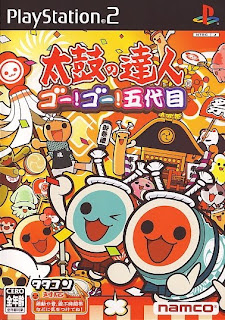
Taiko no Tatsujin- Go! Go! Godaime! song list

Taiko no Tatsujin go Go Godaime boxart

The 5th PS2 Taiko game, released on December 2004. As the title suggests, this is the console game to introduce Go-Go Mode to the Taiko series, where choruses of songs light up with fire and extra points are handed out to the player. Doron Mode (invisible notes) was also introduced in this version, together with the Yam note. In fact, the theme song of Godaime sings about yam half the time too. Godaime is pretty vocal about the changes it made to the Taiko series.

Doron Mode can't be unlocked or selected normally, and can only be accessed through a secret code in the game involving setting a specific name to a new save file. This trick, and together with later game modifiers, is repeated for all later Taiko games released on PS2 and PSP. Only after Taiko DS1 was released do the game modifiers have standard unlocking methods and the ability to be selected freely.


~ Ending Movie variants ~
Muzukashii mode credits
Futsuu mode credits
Kantan mode credits

Sunday, September 12, 2010

Taiko no Tatsujin: Atsumare! Matsuri da! Yondaime song list

Taiko no Tatsujin Atsumare Matsuri da Yondaime boxart

The 4th PS2 Taiko no Tatsujin game, released on July 2004, and is the first Taiko game to upgrade to the PS2-grade graphics engine (Namco System 256), even before the arcade did. As a result, the subsequent arcade releases of Taiko 7 and 8 use Yondaime's in-screen menus as their song list/menus layout format.

Yondaime set the trend for unlocking hidden material for the rest of the PS2 and the first two PSP games; the Don Point system. You're awarded a certain number of these points every time you clear a song or complete a minigame. The amount you get depends on the difficulty of the song and your performance. Go past a certain point total and something gets unlocked, whether it's a song, Taiko sound, or the Oni difficulty.

The modes have also been overhauled. Instead of a two-song Arcade Mode, Survival Mode and Battle Mode, everything has been discarded and replaced with a Play Mode (Ensou Game, the main mode where you play everything), where you're allowed to play through the songs as much as you want without restriction (similar to the Free Mode from older PS2 Taiko games). Minigames still prevail through the makeover. Auto-Play also becomes an official modifier option, with Mekadon from Sandaime appearing on the top-left corner instead of Don-chan.

Just for this game and the next, difficulty stars in Kantan aren't regulated. There are actually 6* songs in Kantan in this version and in Taiko PS2 5. Of course, all 6* have been cut to 5* soon after.


~ Ending variants ~
Don-chan Sekai Ryoko (Muzukashii)
Don-chan Sekai Ryoko (Futsuu)
Don-chan Sekai Ryoko (Kantan)


Tuesday, August 31, 2010

Taiko no Tatsujin: Waku Waku Anime Matsuri song list


The first of two PS2 Taiko anime-only compilations, and the last Taiko console game styled after the first arcade generation's graphical style. Waku Waku Anime Matsuri does what it says on the tin: it's jam-packed with nothing but anime songs (and one secret Namco Original).

Released just two months after Sandaime, this Taiko game doesn't have any of the console-exclusive modes from the first 3 Taiko console games. It's also one of the few titles of the series that doesn't feature a single Oni 10* difficulty song in its songlist.


Taiko no Tatsujin: Appare! Sandaime song list

Taiko no Tatsujin Appare Sandaime boxart

The 3rd PS2 Taiko no Tatsujin game, and the last one to feature the Arcade, Battle and Survival modes. Basically, the game is the same as the previous one, featuring the same modes and a new list of songs, together with three new minigames to play with. It's also the only one to feature different Game Over screens at the end of Arcade mode, based on the run being a successful one or not.

While, once again, the game was nothing but an updated/tweaked version of the first two games, it's a remarkable release due to the fact of introducing Linda AI-CUE's infamous 2000 song series, with Saitama 2000 being one of the unlockable tracks.


~ Opening song ~

~ Ending song ~ 

Saturday, August 21, 2010

Taiko no Tatsujin: Doki! Shinkyoku Darake no Haru Matsuri song list

Taiko no Tatsujin Doki Shinkyoku Darake no Haru Matsuri boxart

The follow up to Tatacon de Dodon ga Don, released on March 2003. Basically the same as its prequel, this version does nothing more than put in a whole lot of new songs, with minor tweaks to the features of the previous game.

While using the same graphical style and modes from the first Ps2 title, this version has a full-fledged Minigame Mode, featuring 3 side activities instead of a single one. The game's Safari Mode gets tweaked as well, particularly in the number of songs per play required to finish the mode on each difficulty, due to the first game's insane requirements forcing the player to re-play at least twice all of the game's songlist for a run at higher difficulties!


~ Opening song ~

~ Ending song ~